Practical
What you need
Short, because there is not much to it. The interesting part of this is what a phone can perceive; this page is the unglamorous half.
The whole list
- An Android 8+ phone you are not using
- Power at the feeder — a battery pack or mains
- A second Android phone, the one in your pocket
- Something to keep the rain off — print ours or make your own
- Optional, and the one worth adding: a USB-C thermal camera, about €220
In the order you do it
- Install the app on both phones and give each its role — feeder or viewer.
- Pair them: the viewer shows eight characters, the feeder scans or types them. Seconds.
- Mount the phone, and the thermal camera on its arm, pointing across whatever you want watched.
- Plug in power, start the watch, and walk away. Check it with Look now before you leave.
- Android 8 or newer, with a working camera — but compatibility varies by handset, and we would rather say so than let you find out in a wood. Two we have run for weeks: the Oukitel WP61 (the one every number on this site came from) and a Redmi Note 8T, which drops captures often enough that By sight counts them. Both phones must run Android; the viewer is the same app in a different role.
- Power at the feeder — a battery pack, or mains
- Mobile signal or Wi-Fi, if the alert is to reach you while you are away
- Something to keep the rain off it
That is everything. The app is free at this point and the phone is one you already own.
A USB-C thermal camera, about €220, bought from whoever you like.
We develop against the Thermal Master T2 Max (the sensor and
protocol are InfiRay’s; the module is sold under the Thermal Master name, and
USB 3474:4161 is what identifies it). Other modules speaking the same
protocol should work, and none has been tested.
You will also want a way to charge the phone while the camera occupies the USB port — a rugged phone with charging pins, or a powered hub.
- Across the clearing, not along it. An animal crossing the frame is far easier to separate from the background than one walking straight at you.
- Not at open sky, and preferably not at ground that has had sun on it. Warm earth no longer triggers the way it once did — a shape has to move first — but shade costs nothing and removes the argument entirely.
- Close enough to matter. Detail falls away with distance quickly, and no software recovers what the sensor never resolved. Nearer is better, and a longer lens buys reach at the cost of how much ground you see at once.
- Shaded and vented. A phone in a sealed bag cooks itself and the condensation finds its way in regardless.
Hardware. Every part named here is something you buy from whoever you like and keep if you stop using Strixeo. If a feature would require buying something from us, it does not get built.
That is not modesty. A product that needs you to buy its box reaches the people who can afford the box; one that runs on a phone already in a drawer reaches almost everybody. We would rather make a good thing that everyone already owns the hardware for.
Before you ask
The four questions everybody asks next
The app is free and there is no subscription. We have not decided what, if anything, is ever charged for; if that changes it will be said here before it is said anywhere else.
The only money is hardware you buy from whoever you like: a thermal camera at about €220, a power bank, and filament if you print the housing. The phones are ones you already own. We sell none of it and never will.
Measured at a feeder on an Oukitel WP61 (76,800 mWh), screen off:
- 193 mW listening with the camera shut — about 16 days
- ~790 mW with a thermal camera streaming — about 4 days, or nearer five on the camera handle's own cell
- 3.45 mWh per visit, which at thirty-odd visits a night is rounding
Cold weather, a weak signal and a busy night all cost more than this. A 20,000 mAh bank takes the thermal setup past a week.
A USB-C thermal camera occupies the only port the phone has, which is also how you charge it. There are two ways round it and you need one of them:
- a rugged phone with pogo charging pins — what we use;
- a powered USB-C hub that charges and carries data at once.
Not every hub manages both on every handset. This is the single most likely thing to go wrong in a build, so test it on a table before it goes up a tree.
It keeps working. Noticing, photographing and naming the species all happen on the feeder phone, offline — no network is involved in any of it.
What needs a network is telling you. An alert that cannot be delivered is not discarded: the sighting stays queued and goes out on a later pass, so a feeder that loses signal for an hour sends that hour's visits when it comes back.
The live view is the exception. It is a call between two phones, so it needs both of them reachable at the moment you tap.
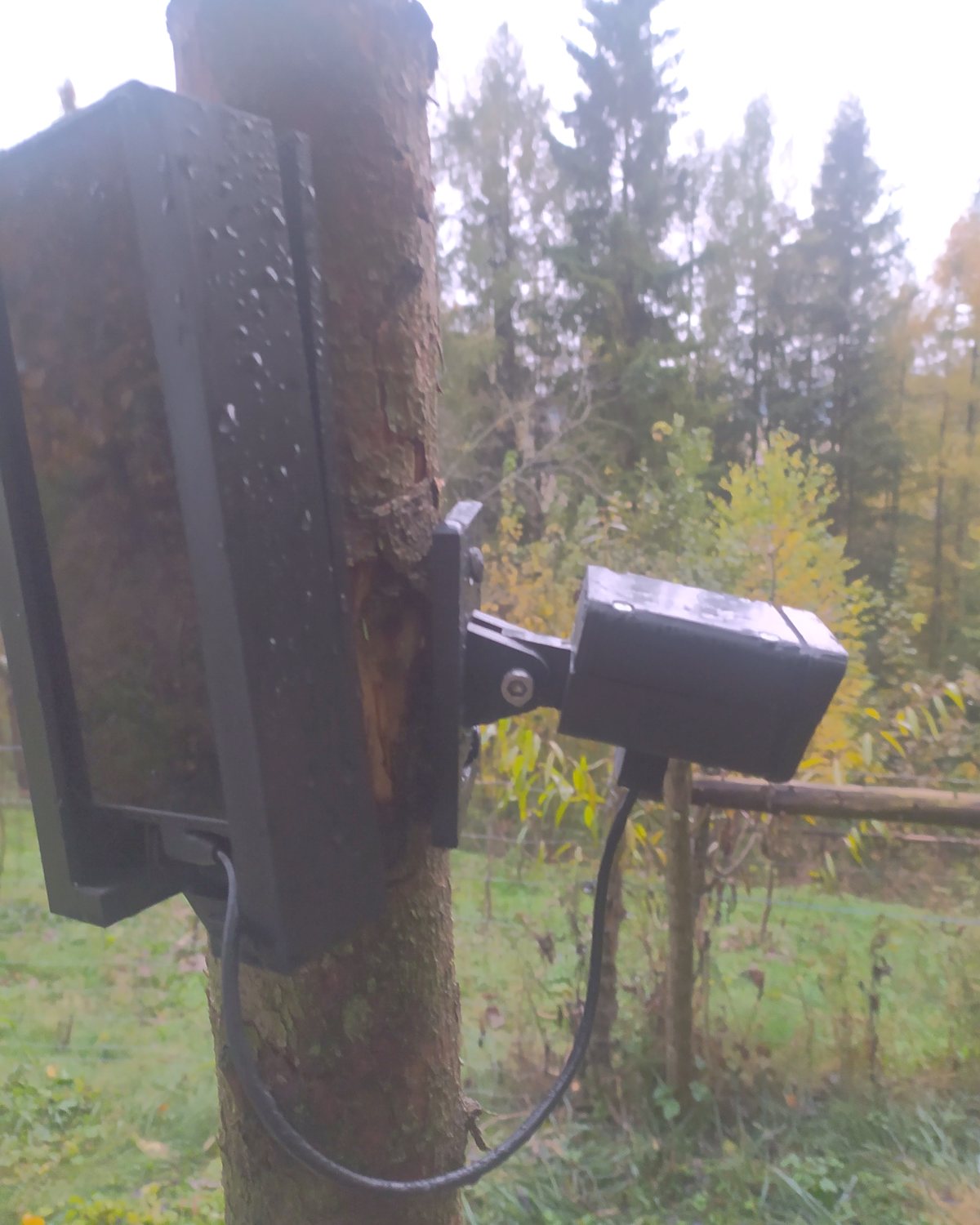
How it actually sits
A housing, an arm, and somewhere to bolt them
The phone goes in something that keeps the rain off. The thermal camera goes on an arm beside it, pointed at whatever you want watched — it does not have to look where the phone looks, and usually should not.
The loop in the cable is deliberate. Water runs down a cable and collects at the lowest point; a loop below the socket means the lowest point is not the socket.
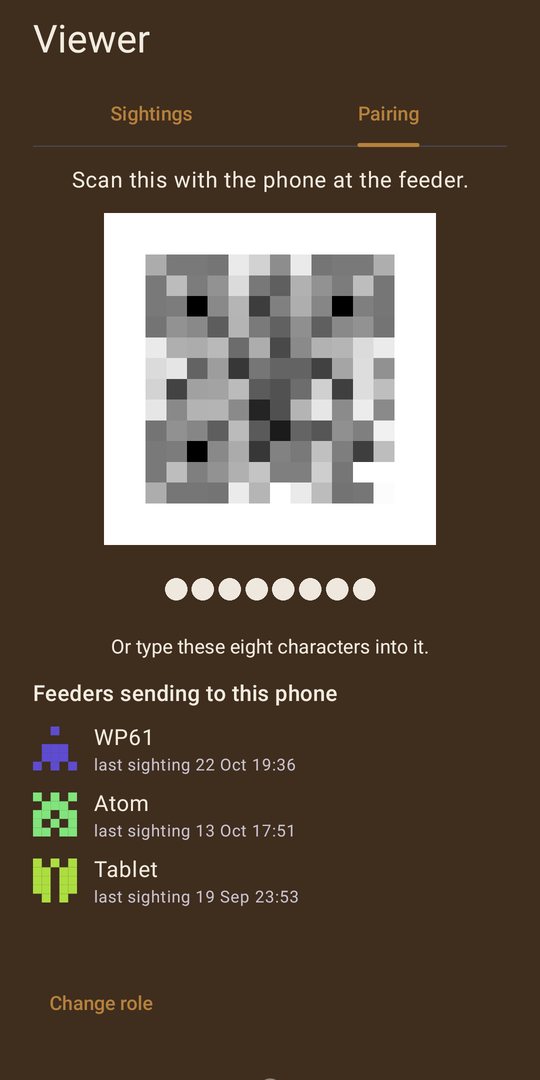
The code and the QR are masked here. The three feeders below are real, with the last time each of them saw anything.
Two phones, one code
How the feeder finds you
The phone in your pocket is the viewer. It shows eight characters and the same eight as a QR code. The phone at the feeder scans it, or you type them in if the light is bad. That is the whole of the setup.
The code is checked while you are still standing there. The feeder announces itself, and a code that names no phone is refused on the spot rather than discovered days later by the absence of alerts — a Q read as a W on a small screen in a field cost us an evening before it worked this way. The viewer gets a notification too, so “did it work?” is answered on both phones.
One viewer holds as many feeders as you like. The list underneath is them, each with the last time it saw anything — which is also how you notice one that has stopped.
Live
Look now
A feeder spends the night with its camera shut. That is what makes a night on one battery possible — and it is also why there is a button that opens it.
Tap Look now on the viewer and a silent message goes to that feeder: the one thing Strixeo sends that is not meant for a person to read. It carries no notification, because its whole purpose is to run code — it starts the watcher, and the watcher opens the camera.
The two phones then hold a WebRTC call for as long as you watch — the same machinery a video call uses — straight between them where the network allows it and through a relay where it does not. The thermal picture arrives at five frames a second and nothing is recorded. The camera delivers about ten; five is smooth enough to tell a standing animal from a still picture, which is the only question anybody asks of a live view, and the other half are not worth the encoder time on a battery.
If the picture stops changing for two seconds the view goes quiet instead of carrying on. Two identical seconds means the camera has stopped or the feeder has gone dormant, and an hour-old frame presented as live is worse than no frame at all. With more than one feeder paired, it asks which one you meant before waking anything.
When you stop watching, the camera closes again.
Experiments — not part of the product
Thermal from the air, for a few hundred
Nothing here is something you can use, buy or rely on. It is what we are trying, published because it is more interesting than silence.
A thermal drone costs several thousand euro. The same camera clipped to a cheap consumer drone costs a fraction of that — and on 16 October it flew.
| Part | Roughly |
|---|---|
| A used Mavic Mini 2 | €250–350 |
| The same thermal camera the feeder uses | €220 |
| A printed cradle | pennies of filament |
| A thermal drone, instead | several thousand |
The aircraft lifts it and handles normally. That is the one thing the flight proved, and it is the expensive question answered cheaply.
Nothing else about this is built. Every measurement Strixeo makes assumes a camera standing still — the scene is the middle of the frame, and a warm thing moving against it is an animal. From the air the whole frame moves and that reasoning stops working. It is a different detector, not a setting. One practical note: a Mini 2 is 249 g, so any cradle puts it over 250 g and into a stricter subcategory of the same Open category.