Optics
How far it sees
Two questions that sound like one. Noticing something warm and recognising what it is happen at completely different distances — roughly five times apart — and most of what people expect from a thermal camera comes from confusing them.
The two distances
Noticing is easy. Knowing is not.
A warm body only has to be a handful of pixels to stand out against cold ground and be followed from frame to frame. To be named it has to be large enough to still have a shape — ears, legs, a back — and that needs roughly fifty pixels across.
That gap is why a night can hold hundreds of sightings and almost no species. It is not the classifier failing. At thirty metres a badger is forty pixels by thirty, and there is no badger left in it to recognise.
The lever is the lens. Not the software, and not the sensor alone. A longer lens magnifies, and by doing so sees less ground — which is the trade nobody mentions.
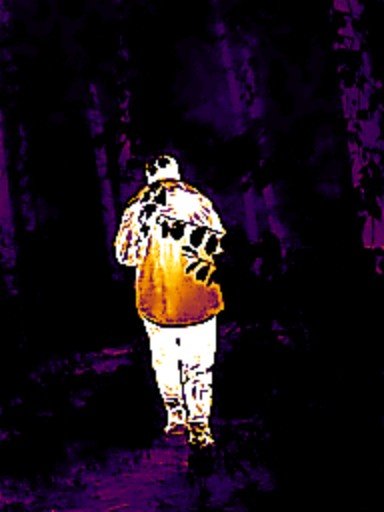
The same subject, further away
Where it stops being a person and becomes a warm shape
All three are the feeder’s own frames, with the white box it drew and the sentence it produced. Nothing here is staged and nothing is retouched.
Named human by the model on the phone.
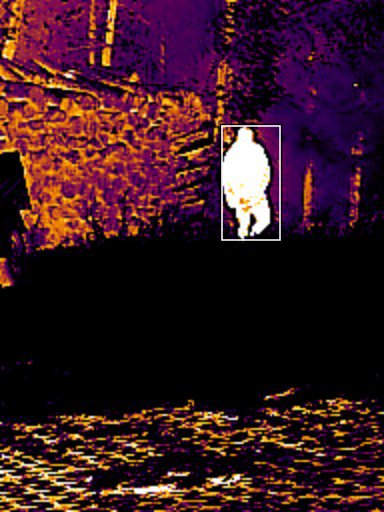
“Large warm body, upright — could be a person.” Not named.
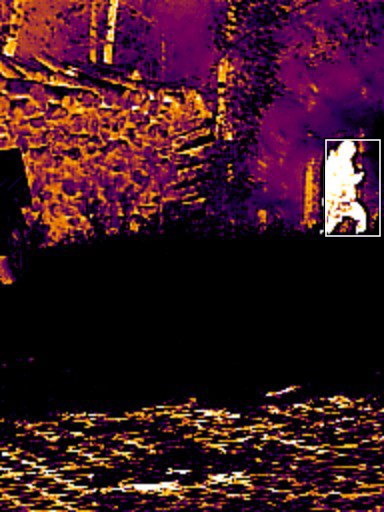
Still found. Still only “could be a person”.
That middle sentence is not a failure message. It is what the feeder honestly knows: large, warm, upright, moving — measured from the shape itself, with no model involved. It arrives in a second and it is right far more often than a species name would be.
What the geometry allows
With the camera we use today
A 256×192 sensor behind a 15 mm lens. Every number below is arithmetic from the optics, not a measurement — see the bottom of this page.
| Distance | Ground per pixel | A 1.2 m deer | |
|---|---|---|---|
| 10 m | 9.6 mm | 125 px | nameable |
| 30 m | 28.7 mm | 42 px | seen, not named |
| 60 m | 57.4 mm | 21 px | a moving smudge |
| 125 m | 120 mm | 10 px | roe deer found here, in the frames below |
| 250 m | 239 mm | 5 px |
So: recognised only inside about 25 m — while noticing reaches very much further than that, as the frames below show.
The same thing, as ground
| Out to | Ground covered | Widest point | |
|---|---|---|---|
| 25 m | 64 m² | 5.1 m | where it can name an animal |
| 60 m | 367 m² | 12.3 m | |
| 125 m | 0.16 ha | 25.6 m | roe deer found at about here |
| 250 m | 0.64 ha | 51.2 m |
Put plainly: it notices warm bodies out to a hundred metres and more, and knows what it is looking at in the first sixty-four square metres. That gap is optics. No amount of software moves it.
Coverage
A long narrow wedge, understood in 64 square metres
The camera sees 11.7° wide by 8.8° high. Aimed along the ground that is a wedge, narrow near you and spreading with distance: out to 200 m about 0.4 hectare, out to 250 m about 0.6 hectare — roughly a football pitch.
It is the shape that surprises people, not the size. At a hundred metres the view is only twenty metres across. Depth it has in abundance; width it does not.
Mounted three metres up and tilted so the far edge lands at 200 m, the strip it actually sees runs from 18 m to 200 m. Anything closer than eighteen metres passes underneath it.
Notice how narrow it is close in. At twenty-five metres the view is only five metres wide — a corridor, not a field. Where you point it matters more than how far it reaches.
Aimed across a field it does not work like a wall at all. The bottom of the frame lands a few metres away and the top runs to the horizon, so the area is far larger and the detail wildly uneven down the picture. That is why the app asks for a nearest and furthest distance rather than one number, and works out what a pixel covers row by row.
Close enough
What it looks like when there is something to recognise
The same camera, the same software, on animals near enough to keep their shape. No model is doing anything clever here — it simply has pixels to work with.
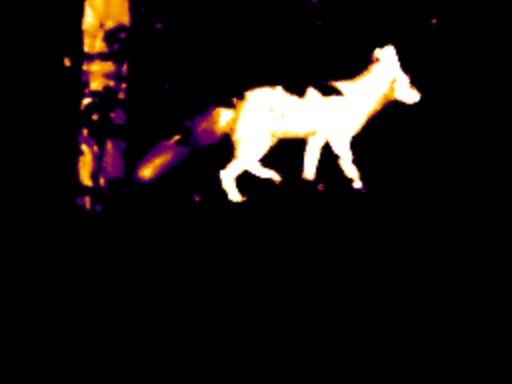
Named at 93 %, 27 September.
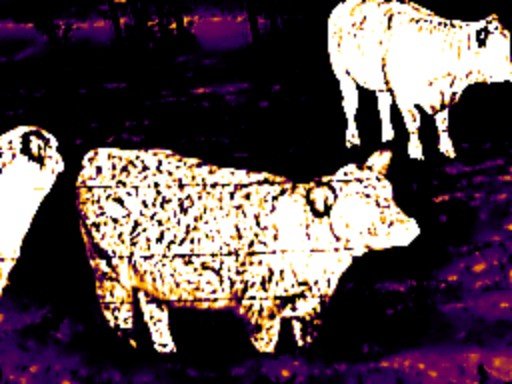
Named at 94 %, 24 September.
Compare those with the deer below. Nothing about the camera changed between them — only the distance.
The percentages are the model’s own confidence in its answer, not a calibrated probability of being right. A 93 does not mean ninety-three foxes in a hundred; it means the model was more certain here than where it prints a 60. We publish the number because it is what the app shows you, and we only let it name an animal above 50.
How far it really reaches
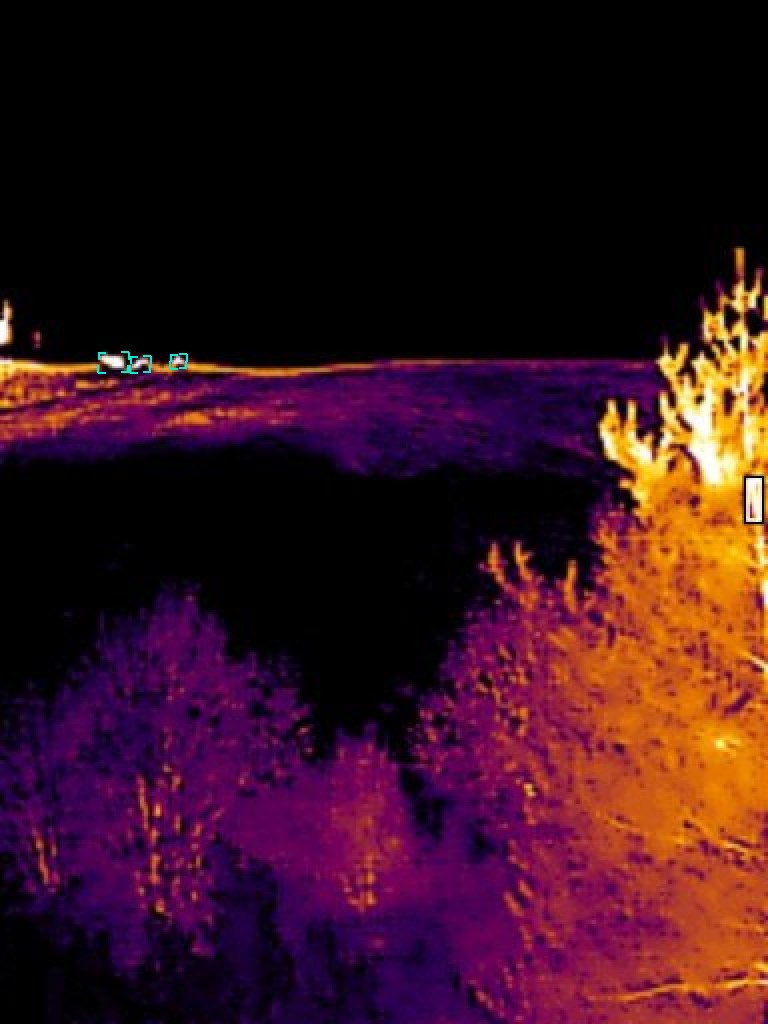
Four pixels of roe deer, found in the dark
These are the feeder’s own frames from the night of 12 October. The cyan brackets are the only thing we added, and they sit outside each animal so nothing is covered. Enlarged beside each, because at this range the whole animal is a few pixels.
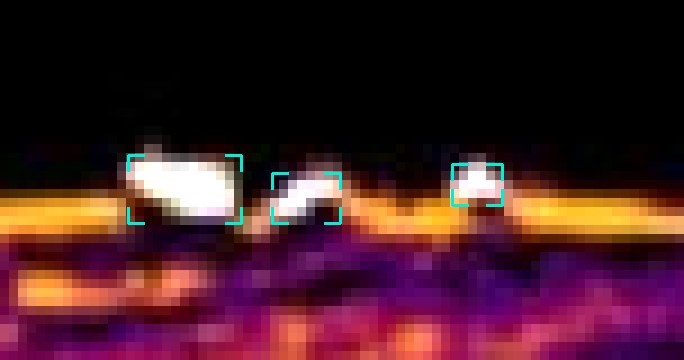
11×6, 6×4 and 4×3 pixels. Found. Not named.
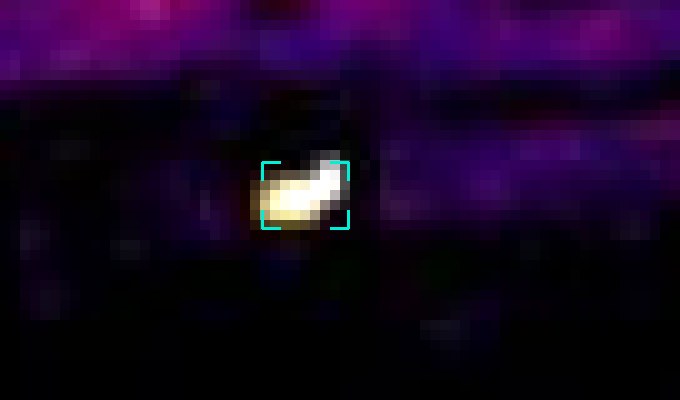
7×5 pixels. Found. Not named.
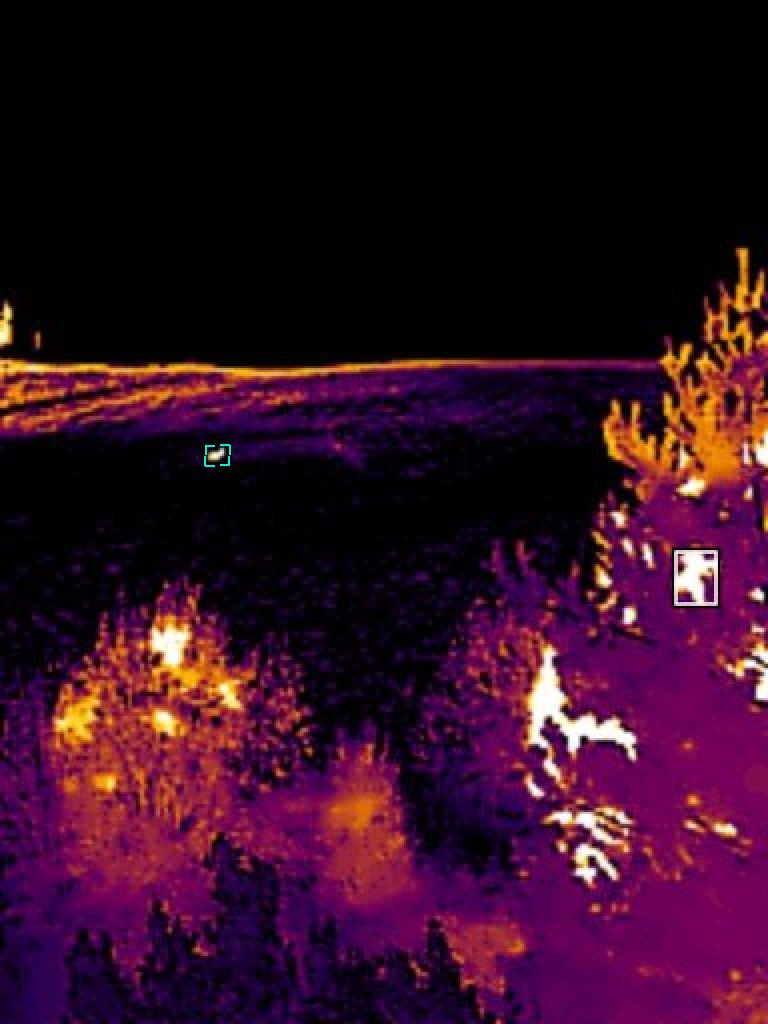
It is the middle of the picture. That is what 210 m looks like.
This is the gap on one page. Roe deer well over a hundred metres out stand plainly against cold ground — thermal does that, and no visible camera would have seen them at all at one in the morning. And at four pixels across there is nothing left to recognise, so each was reported as a warm body and none as a deer.
Where these numbers come from
Measured, and calculated
Measured: a pixel covers 0.957 mm per metre of range — a 168 × 66 mm bottle at three metres spanned 54 × 23 pixels. Every frame on this page is the feeder’s own. The pixel counts on the animals are counted from those frames.
Calculated from it: the distances, the footprints and the hectares. A 256 × 192 sensor at 12 µm behind a 15 mm lens gives 11.7° by 8.8°, and the rest is trigonometry.
The two do not quite agree, and here is the gap. Those nominal optics work out at 0.800 mm per metre, not the 0.957 we measured — about 20 % apart. Read backwards, our measurement implies an effective focal length nearer 12.5 mm than 15, and a field of view nearer 14° than 11.7°. Which is right is not settled: it rests on one bottle at three metres, and both the range and the edges of a blurred thermal target carry error.
So, plainly: the coverage figures use the nominal 11.7° — the narrower, less flattering field — and the animal distances use the measured 0.957 mm, which puts them nearer than the data sheet would. The deer called 110–120 m would be around 135–155 m on nominal optics. In both places the number we print is the one that claims less.
Next: walk a measured line at thirty, sixty and a hundred and twenty metres, and the calculated column becomes a measured one — and this paragraph becomes one number instead of two.